The people whose outfits I notice in July all have this in common
They're not trying harder. They just know which lever to pull.
My hot take is that the people with the best style shine in the summer.
When it’s hot out, many of us stop trying. Not because we don’t care, but because when it’s ninety degrees out, the last thing you want is to think about what you’re wearing. So most of us default to a simple dress and a sandal. One and done. And to be clear, there’s nothing wrong with that.
But the people whose outfits I notice in the middle of July aren’t working harder than everyone else. They’re not over styling themselves either but rather, they’ve figured out how to stay stylish without adding a single layer or breaking a sweat. And it’s not exactly groundbreaking. They’re just being more deliberate with how they use texture, color, and accessories in their outfits.
Consider these three as styling levers for getting dressed in the heat with ease. And you don’t even need to try them all at once. Pick one that matches how you already shop. Start with texture if you’re a neutral-loving minimalist. Drawn to color? You know where to go. If accessories are your weakness, build from there.
Summer Styling Levers
TEXTURE
Most people treat texture as if it’s only a fall/winter thing. Texture actually matters more in the summer because when you strip away the layers, there’s nothing left to hide behind.
Monochromatic outfits are chic but tend to fall flat, and it’s almost always a fabric issue. Wearing the same texture on top and bottom can feel one-note because it lacks contrast.
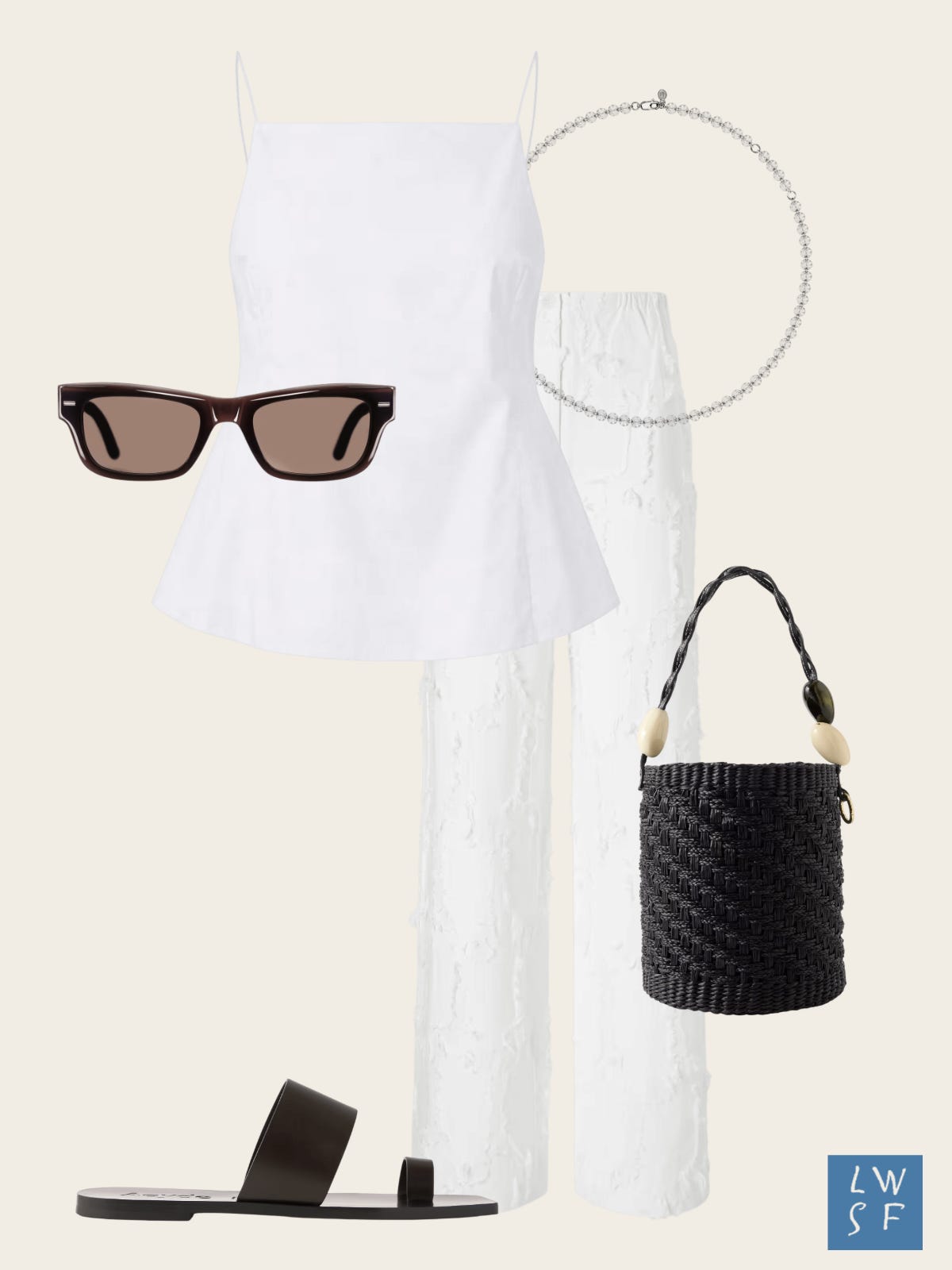
The poplin top and jacquard pants are both cotton, but the poplin is crisp and structured whereas the jacquard is soft, textural and a little bit romantic. The eye has somewhere to land even when color is absent because texture provides depth when there’s nothing else going on.
Another perk of wearing a textured bottom like jacquard or broderie anglaise (eyelet) is that you don’t have worry about those damn wrinkles. Freedom!
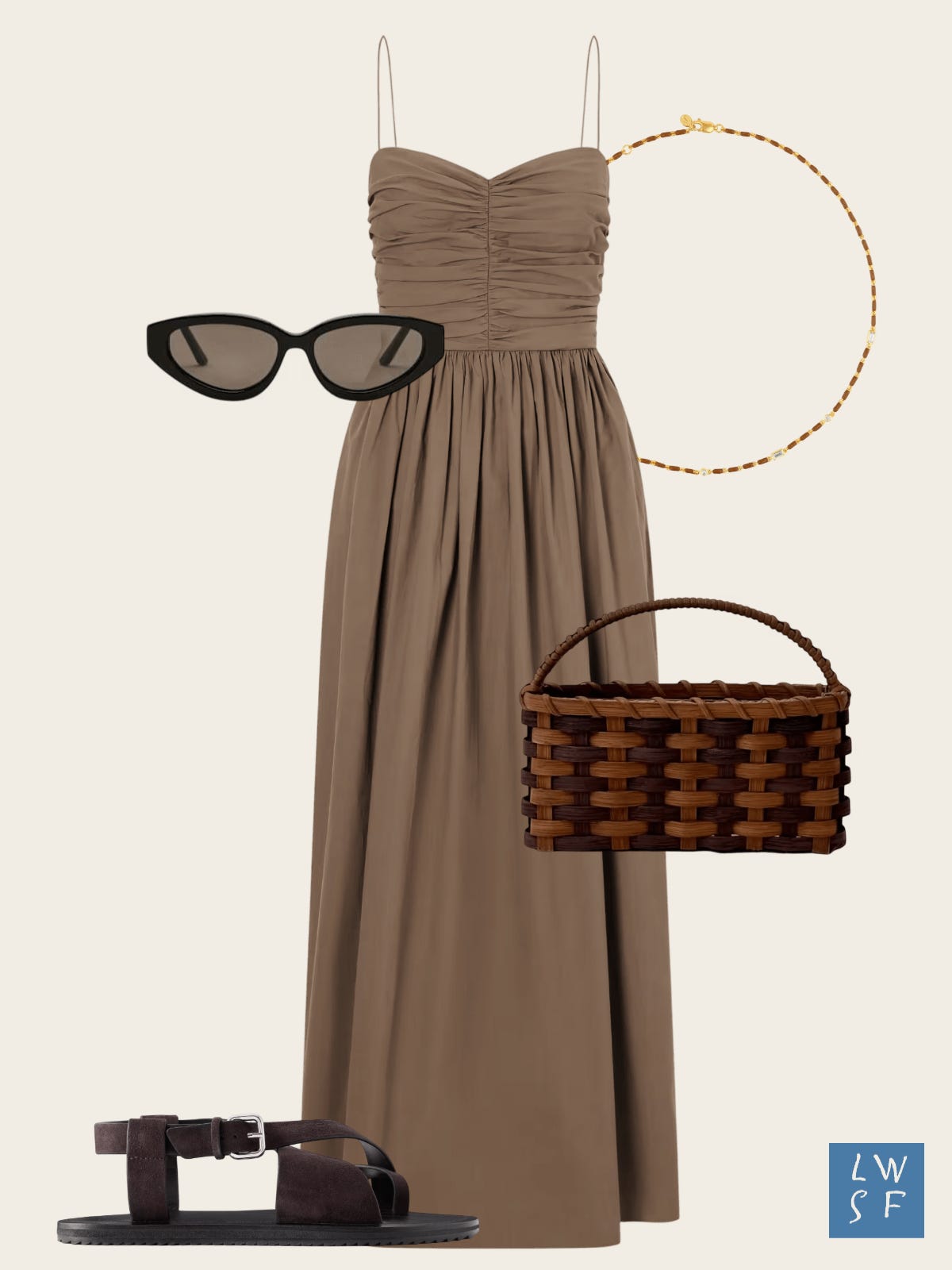
Construction can make an impact too. The ruching on the bodice and the pleats falling from the waist make this dress inherently interesting. A piece with built-in texture from a single fabric is always a winner in my book.
The materials of your accessories also matter here. If you’re going tonal, your bag and shoes can dial up the interest. It may seem counterintuitive to wear a woven basket and a suede sandal together but they actually work. The friction between the materials (rattan = warm; suede = cold) instantly amplifies the overall interest in this look. The unexpected pairing of these two materials don’t feel chaotic since both pieces live in the same color family.
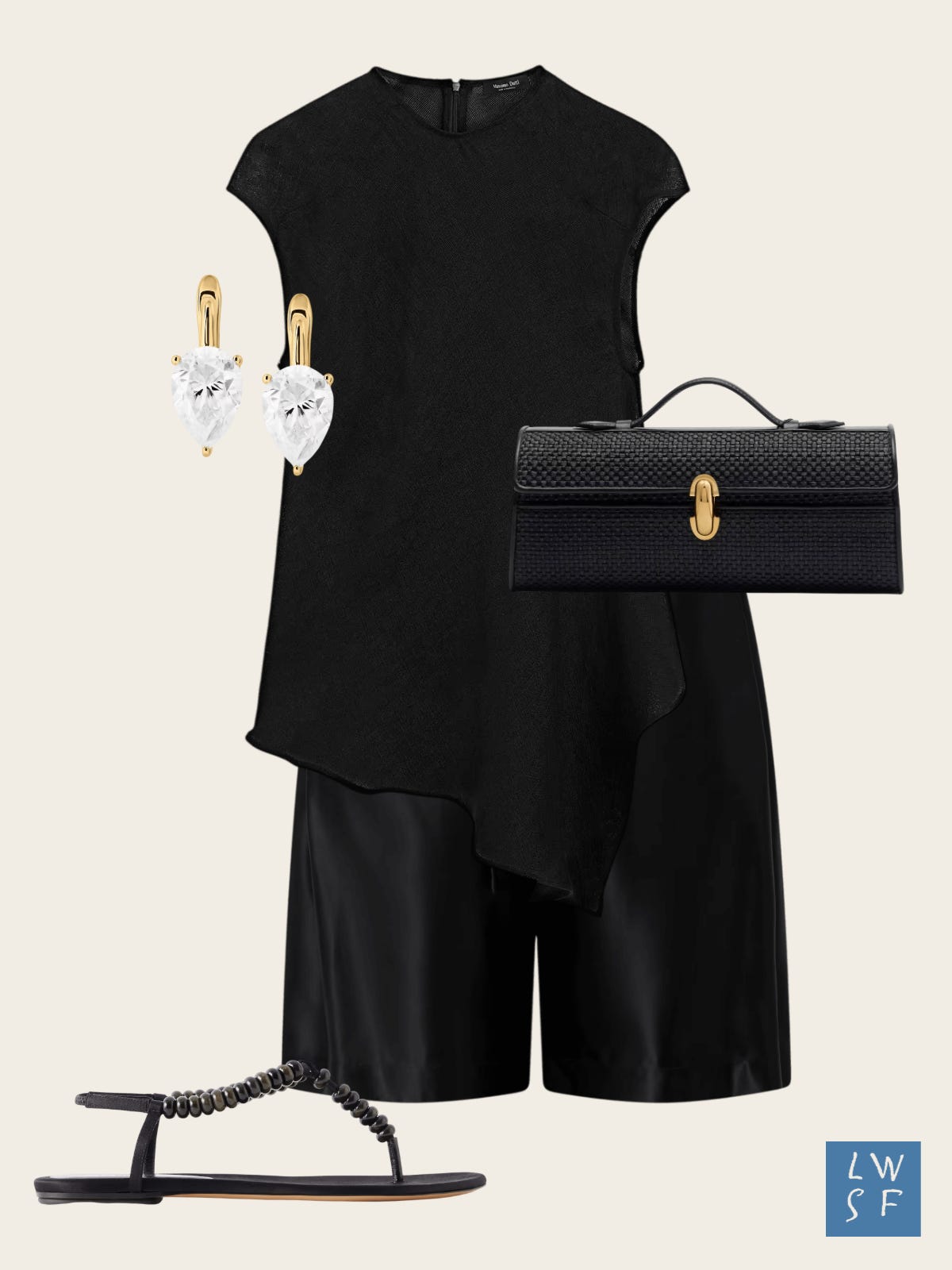
The same logic works just as well in black, with a little more edge.
When every single piece is the same color but all completely different to the touch, that’s when the interest comes through. The linen top is matte and substantial while the silk short is fluid with a little shine. The raffia clutch and beaded sandals have opposing textures at play as well.
Shape and silhouette are also worth exploring during a tonal moment. The asymmetric linen top against the fluid silk shorts provide some structure as well as movement that a basic tee could never. The east-west shape of the clutch and circular beads on the shoe are both interesting on their own but don’t compete within the look.
So what I’m saying is… neutrals in the summer don’t have to be boring when you know how to play with texture.
And if that sounds a lot like what a good color pairing does, that’s because it’s the same underlying principle: texture and color both create contrast. The key is to pick one to vary and let the other hold steady. We’ve done it with fabric above. Now let’s do it with color.
COLOR
People tend to fall into one of three camps when it comes to wearing color in the summer: the pop-of-color person, the more-the-merrier maximalist, and the purist who refuses to abandon their neutrals even in the heat. The good news is there’s a way to make color work for all three.
We all know that Prada green has a point of view. And usually the instinct is to pair black or white when wearing a pop of color because it feels safe and familiar. That pairing creates a high contrast look.
But warmer neutrals do something different when paired with saturated color. The ecru top and brown accessories soften and blend the contrast instead of sharpening it. Now the green feels more wearable and reads more approachable.
High contrast combinations communicate confidence and authority whereas a softer contrast expresses warmth and ease. The takeaway: the colors you wear tell people something about how you’re feeling before you’ve even said a word.

Red and blue is one of my favorite color combos. Together, they can easily read patriotic. And you don’t want that.
As primary colors, both are equally bold and saturated, creating a strong contrast between warm and cool. The tension is built in.
What makes this combo work lies heavily in the undertones. The sandals are a warm, bright blue while the dress is almost a perfect red, with the warm and cool undertones balanced just right. That balance is what keeps this combination from tipping into costume territory.
But two saturated colors together need something to anchor them, and that’s where the accessories come in. The layered necklaces tie the reds and the blues together while the camel woven bag and brown sunglasses ground the look.
If you pull the accessories out, the look falls apart. Keep them and it coheres. That’s CP color math for you, Tibi die-hards (you already know :))
For the purist who won’t abandon their neutrals even in the heat, this one’s for you.
Wearing taupe-y, brown-ish pieces together have more depth than a single neutral from head-to-toe. The combination feels considered rather than defaulted to.
The “ish” colors (the ones that aren’t quite neutral but aren’t quite bold either) is where the real interest lives. You can try them to venture out of your comfort zone without feeling like you’re wearing somebody else’s clothes.
ACCESSORIES
Most people think of accessories as the finishing touch. But sometimes I build an outfit starting with a single accessory and work backwards from there. It’s actually easier that way since you have one focal point and everything else just has to get out of the way.
The belt above isn’t finishing anything. It’s doing all the color work AND introducing a new texture (turquoise stones, silver hardware against a simple black base) simultaneously. This is the kind of high impact moment a single accessory can create when the base is unfussy enough to let it.
The focal point lands in the same place here, in the center of the body, but achieved by two completely different accessories. If you don’t have a statement belt or pendant, tying a printed scarf around the waist works just as well.
The principle is the same: a singular piece creating the impact while everything else steps back.
And for the last look, we go all in.
When every accessory is interesting at once, keep them in the same color family. Start with an unfussy base like a neutral linen dress without any extra embellishment. The sunglasses, bag, sandals, and necklace despite being in the same color family don’t feel matchy-matchy because texturally they’re all different.
There’s a lot happening in this look, but it doesn’t feel chaotic because every piece is talking to each other in the same group chat.
If you’ve made it this far and you’re thinking, “okay, but I still don’t want to think about this” — that’s exactly what I’m here for.
Whether it’s a summer trip you’re trying to pack for or your everyday rotation that needs a refresh, I can help you figure out what you actually need so you can stop overthinking. Book a free discovery call and we’ll take it from there.
x Angela


You are so great at distilling and organizing your information. I always learn things and feel smarter about how to get dressed!
I am obsessed with ALL of these, Angela— I trust you so much if you told me to wear a paper bag, I would.